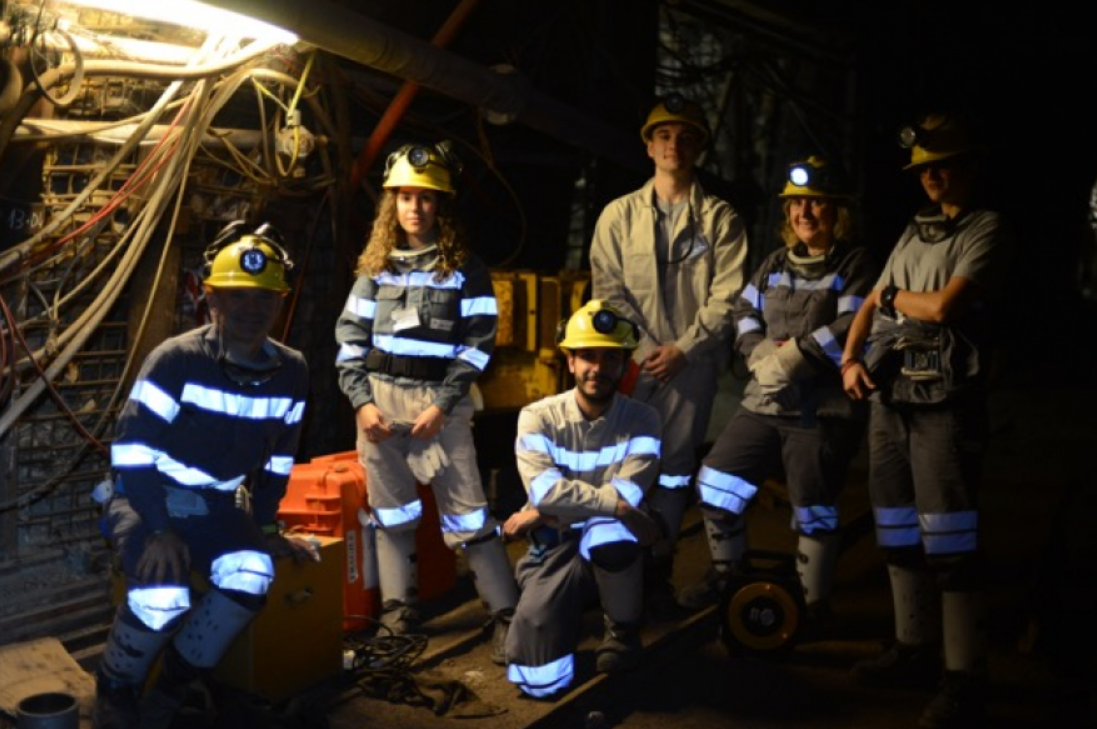
As part of the EEE Project, interesting measurements are underway concerning the flux of cosmic muons in the Sulcis Iglesiente mines, in Sardinia. In the mine of Nuraxi Figus three portable muon detectors, called “EEE cosmic boxes”, have been collecting data for months in order to measure the effect of attenuation of the cosmic particle intensity when crossing thick layers of rock. To determine the form of the attenuation law according to the quantity of material crossed, it is necessary to collect data corresponding to various thicknesses: therefore, measurements have been planned and carried out at different depths inside the mine. To ascertain how much matter the muons must cross, it is essential to know exactly the depth at which the site is located and the composition of the terrain above the measuring point, information available thanks to the mining studies achieved during the construction of the mine itself. It is exactly the inverse process of a muography: we know the layer and its composition, we know the flux at the surface, and we determine the attenuation. To obtain an adequate statistic measurement times are variable: for superficial depths, hours or days are required, but for the lower ones, data are taken for weeks or even months. Measurements are possible for such extended times thanks to the availability and support of the staff of Carbosulcis S.p.A. and the presence of electricity in the entire underground complex. Currently 4 measurements have been made, the deepest of which has an overlying layer of rock of 500 m. Finishing measurements are in progress at intermediate depths, currently the developments of those at -170 m depth (250 m thickness) are being followed. In addition to the Cagliari INFN researchers involved in the EEE Project, some students from the Licei Pacinotti and Michelangelo di Cagliari also took part in this activity and, accompanied by their teachers, went down to the mine to place the detectors and record the readings. The analysis of the data collected is currently in progress.