

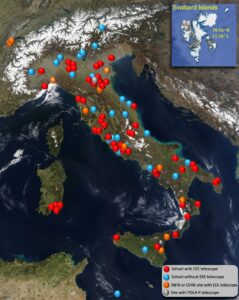
The Extreme Energy Events Project – Science in Schools (Progetto EEE) is an experiment for the detection and measurement of cosmic rays with an innovative outreach program for the dissemination of scientific culture among younger generations. It thus represents a special activity of the Centro Ricerche Enrico Fermi (CREF), in collaboration with the Istituto Nazionale di Fisica Nucleare (INFN), two public entities of the Ministero per l’Università e Ricerca (MUR). Officially presented at CERN (Geneva) in 2004 by its founder, Prof. Antonino Zichichi, the project enables Italian high school students to participate in every phase of a real cosmic rays physics experiment, from building the detectors to their installation, monitoring their operation and analyzing the acquired data. To date the project involves each year more than 1000 students and teachers from 80 upper secondary schools across the national territory. Cosmic rays, discovered over a century ago, continue to be of fundamental importance for studying the Universe; questions remain about their origin and, in part, the acceleration mechanisms (one of which was proposed by Enrico Fermi in a 1949 article [Phys. Rev. 75, 1169, 1949]), to which researchers still seek answers. The EEE Project is currently engaged in monitoring the cosmic-ray flux and in studies investigating correlations with astrophysical events, geographic latitude, and atmospheric and climate-related phenomena. Beyond their strong scientific value, the study of cosmic rays also represents a powerful educational resource: they are, in fact, a formidable educational tool, particularly in STEM disciplines. Their measurement and study constitute an ideal bridge between school and research, between theory and practice, and allow advanced concepts in modern physics—such as the structure of matter, fundamental interactions, relativity, and high-energy astrophysics—to be introduced naturally within school curricula. The fascination of cosmic radiation, combined with the concrete possibility of “seeing” and measuring it, stimulates curiosity and promotes active learning
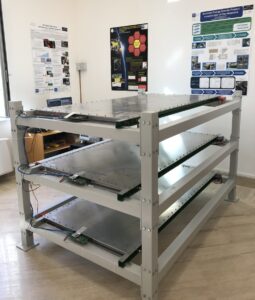
The EEE network, currently consisting of about 50 telescopes, represents the most extensive observatory based on MRPC (Multigap Resistive Plate Chamber) detectors for monitoring the cosmic ray flux. MRPC telescopes are capable of detecting at ground level, with excellent spatial and temporal precision, the secondary cosmic muons produced by the interaction of a primary cosmic ray with the Earth’s atmosphere. The time synchronization of the different stations via GPS receivers enables correlation studies between events acquired by the network’s telescopes, both over short and long distances. The construction of the detectors is performed by students (supervised by EEE Collaboration researchers) and the subsequent installation of the telescopes in schools is an innovative approach aimed at actively involving them, promoting the dissemination of scientific culture through experimental practice.
Since 2014, EEE has been organized into coordinated data acquisition phases called Run, whose duration coincides with the school year: the network’s telescopes operate simultaneously and efforts are made to ensure the maximum efficiency of the observatory. To this end, students and teachers participate in periodic meetings, the Run Coordination Meetings, which allow updates on the network’s status; additionally, an in-person meeting with the project’s schools is organized every year.
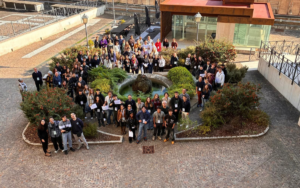
Many activities take place during the school year, both at a national and local level, such as participation in school open days, the European Researchers’ Night and other international initiatives like the International Cosmic Day. Once a year, EEE Project schools also have the opportunity to meet in person to delve into topics related to the experiment through lectures and exercises (masterclasses). During these study days, students are also called upon to present to the entire audience the results of work carried out within EEE during the year.
In particular, in 2018, the POLA-01 detector, as part of an interdisciplinary scientific mission (https://polarquest.org/2018/) held on the 90th anniversary of the Dirigibile Italia tragedy, was installed aboard the Nanuq, which circumnavigated the Svalbard Archipelago, measuring the cosmic ray flux up to 82°; simultaneously, the POLA-02 and POLA-03 detectors operated inside two schools—one in Bra (TO) in Italy and the other in Nesodden (near Oslo)—for reference measurements.

In 2019, thanks to collaboration with the Institute of Polar Sciences of the CNR, three detectors were then installed in Ny-Ålesund on the Svalbard Islands (Norway) for the study and continuous monitoring of cosmic ray flux at extreme latitudes. This continuous and long-term monitoring of the cosmic ray flux allows the study of periodicity effects related to various phenomena, including the solar cycle.
With another POLA-R detector available, it was possible to continue mobile measurement campaigns to study and complete the measurement of cosmic ray flux as a function of latitude. Indeed, in 2022, it was embarked on the ship Amerigo Vespucci (2022), which circumnavigated our peninsula. In 2025, the PolarquEEEst – OvEEErland mission saw EEE Collaboration researchers drive across Europe in a car to take the POLA-02 detector
from Bologna to Tromsø and back to complete the measurement of cosmic ray flux as a function of terrestrial latitude.
In 2024, the EEE Project celebrated 20 years since its launch, and for the occasion, a special issue of the Giornale di Fisica was prepared: Bringing Science in the Heart of the Young – The Extreme Energy Events Project (2004–2024), Giornale di Fisica Supplement Vol.65, S3(2024)1-192.
The activities of the Extreme Energy Events Project continue and continue to involve students from all over Italy!
Introductive Video to the Project
The Museo Storico della Fisica e Centro Studi e Ricerche Enrico Fermi is a public research institution and museum of the history of physics dedicated to the life, experiments, and studies carried out by Enrico Fermi in the 1930s and by the “Ragazzi di Via Panisperna.” Reformed as a research centre by a law in 1999, since 2019 it hosts the museum dedicated to the roman physicist and various lines of research in physics, including cosmic rays, computational photonics, physics applied to cultural heritage, complexity fitness.
The Istituto Nazionale di Fisica Nucleare (National Institute for Nuclear Physics) is a public research institution established in 1951. It conducts research in fundamental physics and is internationally recognized as one of the most prestigious scientific institutions in the fields of nuclear physics, particle physics, and astroparticle physics, as well as in the development of technologies for research and their applications for the benefit of society.
The Ettore Majorana Foundation and Centre for Scientific Culture is named after an extraordinary Italian physicist born in Sicily in 1906. The Centre is located in the ancient city of Erice, within four restored monasteries.
MUR stands for the Ministry of University and Research. It is the Italian governmental body responsible for promoting and developing scientific and technological research activities, as well as managing the university system and higher institutes for artistic, musical, and choreutic education (AFAM).
The European Organization for Nuclear Research, commonly known by the acronym CERN, is the world’s largest particle physics laboratory, located on the border between France and Switzerland, on the western outskirts of the city of Geneva. Its main purpose is to provide researchers with the tools necessary for research in high-energy physics, primarily particle accelerators that bring atomic nuclei and subnuclear particles to very high energies, and detectors that allow the observation of the products of collisions between beams of these particles.
The Società Italiana di Fisica (Italian Physical Society, SIF) is an association aimed at promoting, supporting, and protecting the study and progress of physics in Italy and worldwide. It was founded in 1897, with its original headquarters in Via Panisperna; the founding group was coordinated by Pietro Blaserna, who was also the society’s first president. The current headquarters is in Bologna.