

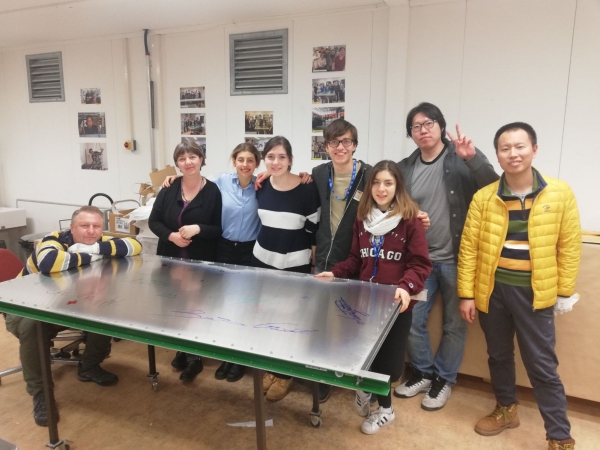
During the week 03/18-23/2018, five students from the “Augusto Righi” Scientific Lyceum in Rome travelled to the Geneva Cern to participate in an initiative of the Extreme Energy Event (EEE) Project, which allowed them to experience first-hand work in a practical physics lab. The small group of students, which was accompanied by the Physics professor Francesca Sartogo, in the five days of its permanence, was able to build two of the three chambers necessary for the assembly of an EEE particle detector telescopes. The lyceum is still anxiously awaiting the possibility to host its own telescope; however, the students are still grateful to have been given the opportunity to build MRPC chambers. After their first day settling in, the students began working strenuously from Monday on.
They were divided in two groups and guided by the supervisors of the project, as the students started assembling the first chamber, which had been left uncompleted by the preceding group of High School students. The groups were alternated periodically between various tasks, such as the cleaning of the glass sheets-which would be placed internally to the chambers- and the drawing of guidance lines for the application of the internal copper lines. During this process, Physicist Raman Zuyeuski would illustrate the theoretical principles that come into action inside an active chamber and the proper procedures used when collecting and elaborating data. After having completed the first chamber, the students were able to build the second one almost in complete autonomy, except for a few crucial indications from Raman and his collaborators, Zheng Liu and Woosung Park. On Thursday, given the advance state of their work, the students were able to take advantage of the winter rest-time of the LHC and visit ALICE, an experiment which focuses on the study of the aggregation state of matter a few microseconds after the Big Bang. The students made a tour of the site guided by Despina Hatzifotiadou, who is the Outreach Coordinator of the experiment. After having worn protective helmets, the students descended 54 m below earth, to the Heart of the famous detector. However – as the students say – it was during the various meal-breaks, at the CERN cafeteria and dorm kitchen, that the students were really able to immerse themselves in the CERN experience. They were able to meet scientist and professors from all around the world, who would share their local cuisines, along with their culture, as they were studing or discussing recent scientific innovations and breakthroughs. Finally, after a productive week, the students were able to return safely home. Although tired, they were happy they had the opportunity to discover more about what goes over our heads every day (muons) and that somewhere, in a lyceum here in Italy, there is a telescopes that holds Chambers with their signatures.
{gallery}LiceoRighi_CERN_MAR18{/gallery}